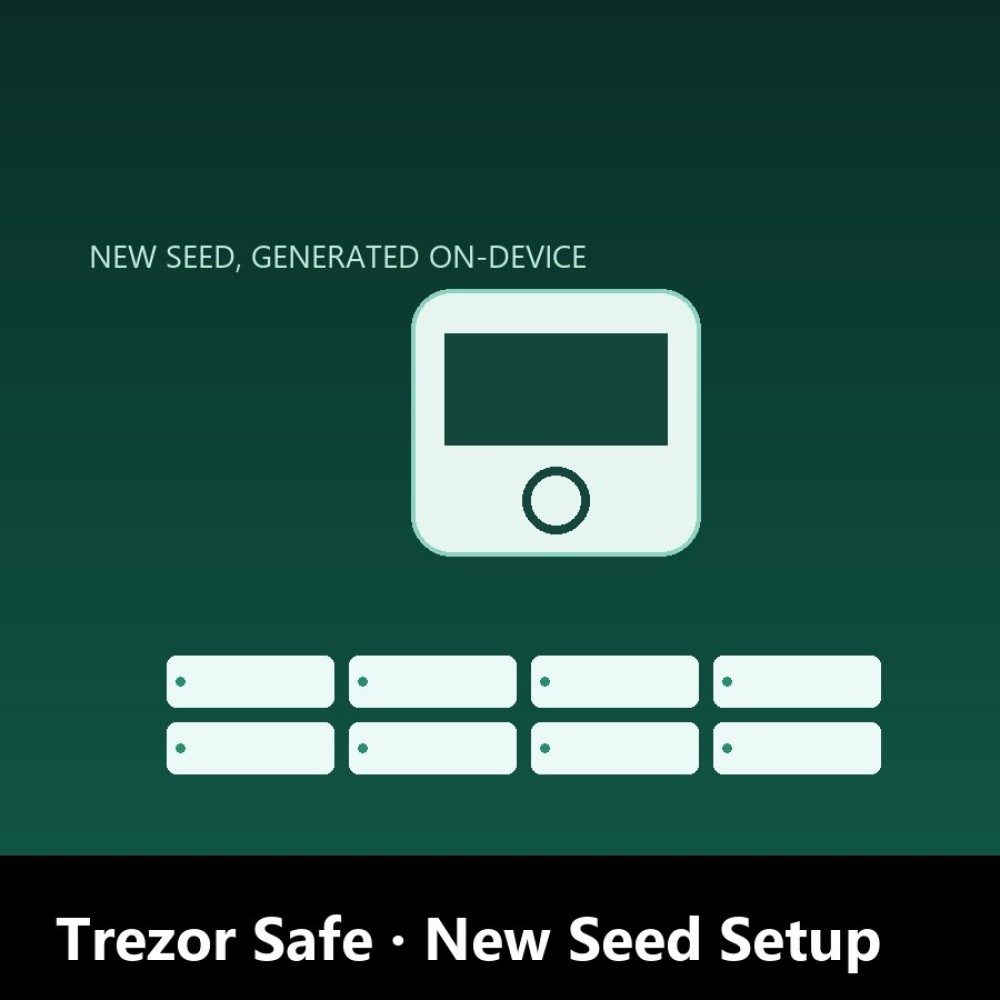
There is something almost anticlimactic about setting up a hardware wallet for the first time: you plug in a small plastic device, follow a few prompts, and a few minutes later you are “done.” But behind that simplicity, the Trezor Safe 3 and Safe 5 are quietly doing something important — generating a private key inside a certified Secure Element chip that has never touched the internet and never will.
Quick overview before the details below:
Why the chip matters more than the screen
Both Trezor Safe models are built around a tamper-resistant Secure Element, the same category of chip used in passports and bank cards. When you tell the device to create a new wallet, this is where the randomness actually comes from — not from your computer, not from Trezor’s servers, and not from any app. That separation is the entire point of a hardware wallet: even a computer riddled with malware can’t see or influence what happens inside that chip.
Before you even plug it in
Check the tamper-evident packaging, and once connected, let Trezor Suite verify the device’s firmware signature. A genuine Trezor will never arrive pre-initialized, with a seed phrase already printed on a card, or with a QR code “to scan for setup.” If you ever encounter that, stop immediately — it’s one of the oldest hardware-wallet scams in the book, and it means someone else already knows the seed.
Create new wallet, not recover
In Trezor Suite, you’ll be offered two very different paths: Create new wallet and Recover wallet. For a first setup, you want the former. This tells the Secure Element to generate a fresh, unique seed rather than asking you to type in words from somewhere else.
12, 18, 24 words — or Shamir?
You’ll then choose how the backup is structured. A standard BIP39 seed of 12, 18 or 24 words is the simplest option and works with virtually every wallet on the market. If you want something more resilient, Shamir Backup (SLIP39) splits the seed into several independent shares — say, 3 of 5 — so that no single piece of paper, lost or stolen on its own, can restore the wallet. Most people are well served by a single 24-word seed; Shamir is worth considering if you plan to store backup shares in multiple locations.
Writing it down — the part that actually matters
The words appear only on the Trezor’s own screen, one at a time. This is the step where good habits pay off:
- Write each word by hand, in order, on paper or the recovery card included in the box.
- Never type the words into a computer, phone, or any app — not even briefly.
- Never photograph the screen or the written list.
- Double-check spelling against the words as shown; Trezor will ask you to confirm a few at random afterward, so accuracy matters.
Once confirmation is done, you’ll set a PIN directly on the device. On the Safe 5’s touchscreen the digit layout is scrambled every time; on the Safe 3 you confirm using the physical buttons while the matrix shows in Suite. Either way, the PIN never passes through a keyboard that malware could log.
Where the seed goes after that
Store the written backup somewhere offline and separate from the device itself — a safe, a bank deposit box, or a fireproof metal plate if you want extra durability. Anyone who later obtains all the words has the same access to your funds that you do, so treat the paper with exactly the same caution you’d give the crypto itself.
That’s really the whole process: a few on-screen prompts, a short list of words you write by hand, and a wallet that was never exposed to a network at any point along the way.